
Understanding ABS Warning Lights Through Brake System Design
When the ABS (Anti-Lock Braking System) warning light turns on, it’s easy to feel concerned—or confused. While many drivers assume it means complete brake failure, the reality is usually more specific. The ABS warning light indicates a fault within the anti-lock braking system, and understanding how the brake system is designed makes troubleshooting faster and more accurate.
What the ABS Warning Light Is Really Telling You
The ABS warning light activates when the vehicle’s control module detects a malfunction in the anti-lock braking system. This does not usually mean you’ve lost normal braking ability. Instead, it means the ABS feature—which prevents wheel lockup during hard braking—may be disabled until the issue is resolved.
Modern braking systems rely on electronic communication between sensors, hydraulic components, and control units. A fault anywhere in this architecture can trigger the warning light.
How Brake System Architecture Affects Diagnosis
ABS systems are built as an integrated network rather than a single component. Understanding how these parts work together is key to pinpointing problems efficiently.
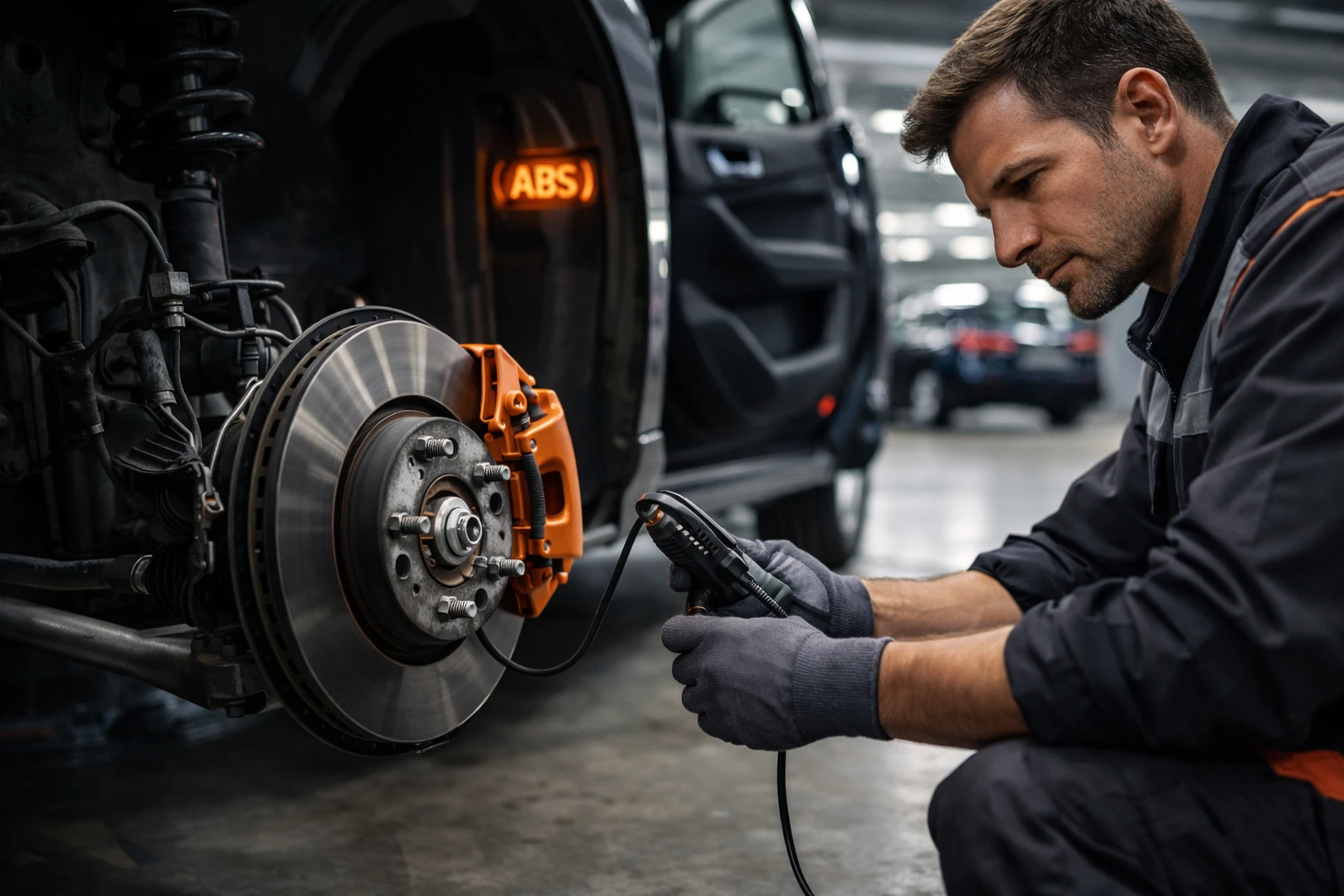
Key architectural elements include:
-
Wheel speed sensors that monitor individual wheel rotation
-
Hydraulic control unit (HCU) that modulates brake pressure
-
ABS control module that processes sensor data and commands the HCU
-
Electrical wiring and connectors linking all components
Because these components operate as a system, a failure in one area can affect others. For example, a damaged wheel speed sensor wire may appear as a control module fault during diagnostics.
Common ABS Warning Light Causes (By System Area)
Instead of guessing, it helps to group ABS issues by where they occur in the system:
Sensor-Level Issues
-
Dirty or damaged wheel speed sensors
-
Corroded sensor connectors
-
Incorrect sensor alignment after brake work
Hydraulic System Issues
-
Low brake fluid levels
-
Faulty hydraulic pump or valves
-
Internal pressure irregularities
Electrical & Control Issues
-
Blown ABS fuses or relays
-
Damaged wiring harnesses
-
Failing ABS control module
Each of these issues interacts differently with the system architecture, which is why scan tools sometimes report indirect or misleading fault codes.
A Smarter Troubleshooting Approach
Rather than replacing parts blindly, use a structured method:
-
Check basic conditions first
Inspect brake fluid levels, battery voltage, and visible wiring damage. -
Scan for diagnostic trouble codes (DTCs)
ABS-specific scan tools provide fault locations that match system architecture. -
Verify sensor data
Compare wheel speed readings to identify outliers or dropouts. -
Inspect related components
Confirm wiring integrity, grounding points, and connector condition. -
Test before replacing
Many ABS issues are caused by wiring or contamination—not failed modules.
Understanding how the system is laid out helps avoid unnecessary repairs and saves time.
Is It Safe to Drive With the ABS Light On?
In most cases, yes—but with caution. Standard braking usually still works, but ABS assistance may be unavailable during emergency stops or slippery conditions. If the brake warning light (not ABS) is also on, or braking feels abnormal, stop driving and seek professional help immediately.
Final Thoughts
An ABS warning light is best viewed as a system alert, not a panic signal. By understanding how the brake system is architected and how its components interact, troubleshooting becomes more logical and cost-effective. Whether you’re a technician or an informed driver, system-level thinking leads to better, safer repairs.
Frequently Asked Questions
1. Can the ABS warning light turn on because of a minor issue?
Yes. The ABS light can be triggered by relatively small problems such as a dirty wheel speed sensor, a loose electrical connector, or low brake fluid. Even though these issues may not affect normal braking, the system disables ABS as a precaution.
2. Will my brakes stop working if the ABS light is on?
No, in most cases your standard braking system will continue to function normally. However, the anti-lock feature that prevents wheel lockup during hard or slippery braking may not be available until the issue is repaired.
3. Why does the ABS light sometimes turn on after brake repairs?
ABS lights often appear after brake work because wheel speed sensors or wiring may be disturbed during repairs. Incorrect sensor positioning, damaged sensor cables, or debris buildup can all cause the system to detect a fault.
4. Can a weak battery or electrical problem cause an ABS warning?
Yes. ABS systems rely heavily on stable voltage. A weak battery, failing alternator, or poor ground connection can cause communication errors that trigger the ABS warning light—even if the braking components themselves are fine.
5. Do I need a special scan tool to diagnose ABS problems?
Yes. Basic OBD scanners often cannot read ABS-specific fault codes. A scan tool designed for ABS diagnostics is required to access detailed error codes and live sensor data needed for accurate troubleshooting.