
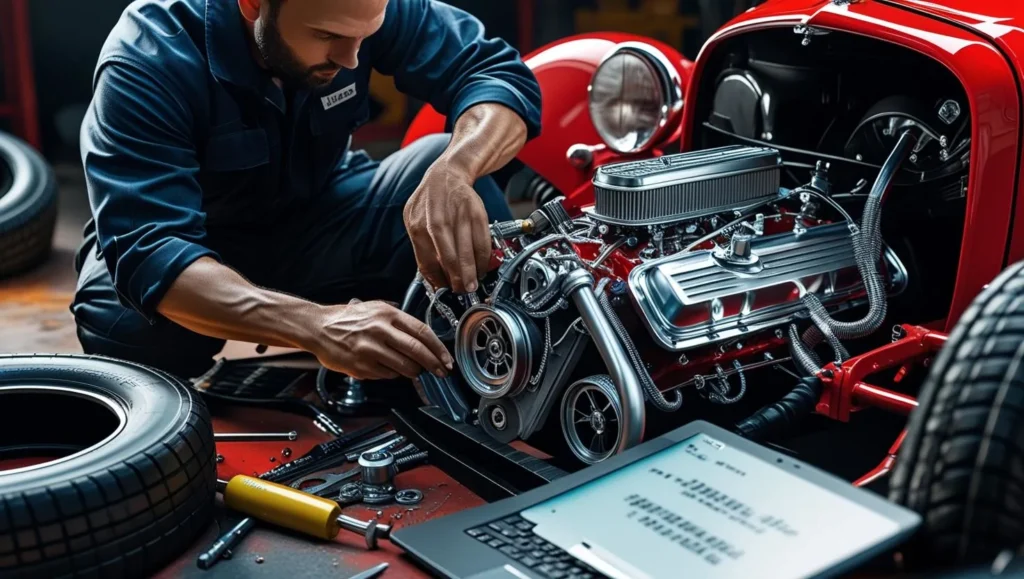
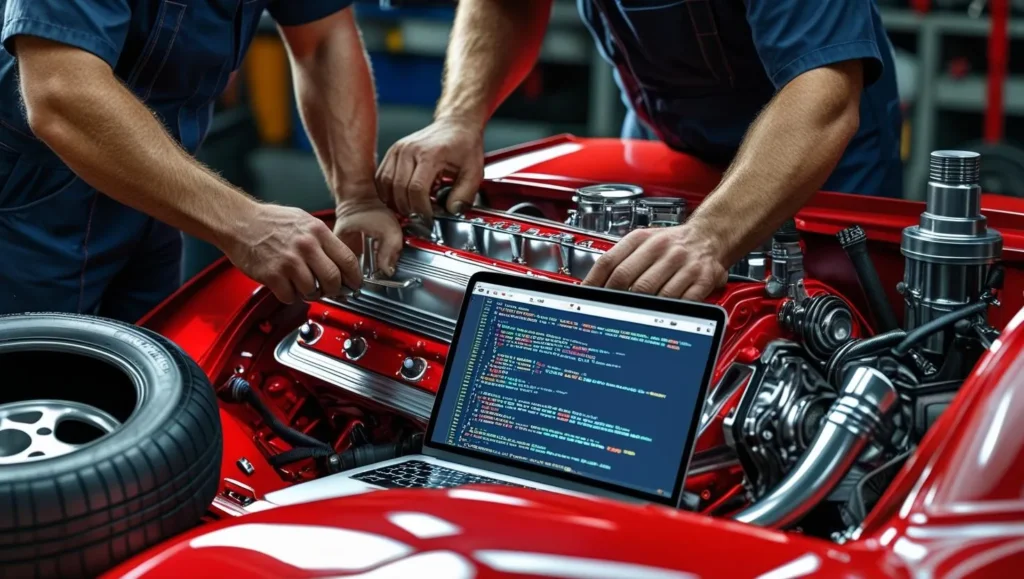
In a sunlit garage, two mechanics stand shoulder to shoulder over a gleaming red classic car. The air smells of motor oil and determination. Around them, car parts are scattered—tires stacked in the corner, tools neatly arranged (and some not so neatly), and engine components laid out like surgical instruments waiting for precision hands. Amidst this mechanical orchestra sits a modern laptop, its screen glowing with lines of data and diagnostic text. It’s a perfect picture of the past meeting the present—craftsmanship intertwined with technology.
This scene isn’t just about fixing cars; it’s about reviving history. Every bolt tightened, and every polish stroke brings life back to a machine that once ruled the roads. Classic car restoration is not merely a profession—it’s an art, a passion, and a dialogue between generations.
The Beauty of Classic Car Restoration
Classic cars hold a special place in the hearts of enthusiasts. They represent an era when design was bold, engines roared with raw power, and craftsmanship mattered more than mass production. Restoring such cars isn’t simply about repair—it’s about preservation.
When a mechanic takes on a restoration project, they’re not just dealing with metal and rubber. They’re uncovering stories. Each dent tells of a journey. Each faded coat of paint whispers about a different decade. A well-restored car isn’t just functional—it’s a time capsule.
For the two mechanics in our imagined garage, every task is an act of respect. They aren’t just tightening bolts or cleaning carburetors; they’re paying homage to the engineers and designers who created masterpieces long before automation took over.
Precision, Patience, and Passion: The Mechanic’s Mantra
There’s something almost meditative about watching skilled mechanics at work. One might be carefully aligning the timing of the engine, while the other methodically sands the fender to perfection. Classic car restoration demands three key virtues: precision, patience, and passion.
-
Precision ensures that every part fits as it should. With older vehicles, components aren’t always readily available. Sometimes, mechanics must fabricate parts by hand or modify existing ones to match vintage specifications.
-
Patience comes into play because restoration takes time. Rushing the process leads to mistakes that can cost more than money—it can compromise authenticity. Some projects take months, even years, to complete.
-
Passion is the fuel that keeps restorers going. Without genuine love for the craft, it’s impossible to endure the long hours, the frustrations of sourcing rare parts, and the meticulous detailing required.
For these two mechanics, the garage is more than a workplace—it’s a sanctuary. They understand that bringing a classic car back to life isn’t just about technical skill; it’s about soul.
The Marriage of Old and New: Technology in Restoration
Notice that laptop perched beside the gleaming red car. Twenty years ago, this might have seemed out of place in a mechanic’s garage. Today, it’s essential.
Modern technology has revolutionized the world of restoration. Mechanics use laptops and digital diagnostic tools to fine-tune engines, monitor performance, and ensure every restored vehicle meets contemporary safety and efficiency standards. Specialized software allows them to model parts in 3D, check tolerances, and even simulate performance before physical work begins.
For instance, when working on a vintage carbureted engine, a mechanic might use digital sensors to analyze fuel-air ratios. The data displayed on the laptop helps them make adjustments that balance authenticity with performance.
Yet, despite the tech, the human touch remains irreplaceable. Computers can measure precision, but they can’t replicate intuition—the subtle feel of a wrench, the sound of a properly tuned engine, or the satisfaction of perfect alignment. That balance between technology and tactile expertise is what makes modern restoration both efficient and artistic.
The Vibrant Red Classic: A Symbol of Revival
The vibrant red color of the car isn’t just a random choice—it’s symbolic. Red is passion, energy, and timeless appeal. For many, the sight of a restored red classic on the road evokes nostalgia and admiration. It’s more than transportation—it’s a statement.
Painting a classic car is a delicate process. Layers of primer, base coat, and clear coat are applied with meticulous care. The goal isn’t just to achieve gloss but depth—a richness that reflects light differently depending on the angle. Under the hands of skilled mechanics, even the paint tells a story of revival.
Every buff and polish brings back the brilliance of the past, merging history with present craftsmanship. When that final coat gleams under the garage lights, it’s a moment of triumph—a reward for hundreds of hours of dedication.
Challenges Behind the Beauty
Restoring a classic car isn’t always glamorous. Beneath the surface lies a world of challenges. Sourcing original parts can be like a treasure hunt. Sometimes, the only solution is to machine parts manually or scavenge from donor vehicles. Rust, corrosion, and outdated wiring are constant adversaries.
Moreover, maintaining authenticity while adapting to modern regulations—such as emissions and safety standards—requires creativity and technical know-how. Mechanics must balance preservation with practicality, ensuring that the restored car isn’t just beautiful but also drivable.
Even the smallest oversight—a mismatched bolt, an incorrect trim—can diminish the car’s value. That’s why professional restorers document every step meticulously, often using laptops to log progress, record part numbers, and maintain digital archives of restoration stages.
More Than Mechanics: The Emotional Connection
For many restorers, these cars are personal. Some work on vehicles passed down from family members, others on dream cars they admired in their youth. Each restoration is a journey—a blend of nostalgia and fulfillment.
The two mechanics working side by side might share stories as they work—one teaching the other, bridging the gap between generations. Perhaps one is a veteran who learned his trade in the era of carburetors, while the other is a younger enthusiast raised on electric vehicles and digital diagnostics. Together, they embody the evolution of the automotive world.
The garage becomes a classroom, a workshop, and a time machine all at once.
The Final Moment: When the Engine Roars Again
After weeks of labor, the moment finally arrives. The car is reassembled, polished, and ready. One mechanic slides into the driver’s seat, turns the key, and listens as the engine sputters—then roars to life. The deep rumble echoes through the garage, bouncing off the walls like applause.
That sound isn’t just mechanical—it’s emotional. It represents perseverance, craftsmanship, and a deep respect for history. For the two mechanics, it’s the sound of success, of a machine reborn.
Conclusion: Keeping the Past Alive in a Modern World
Classic car restoration is more than maintenance—it’s preservation of culture and artistry. It’s where grease-stained hands meet digital precision, and where old engines meet new technology. The sight of two mechanics meticulously working on a vibrant red classic car, surrounded by scattered tools and a glowing laptop, captures the essence of modern restoration perfectly.
It’s a reminder that while technology evolves, passion remains timeless. Whether through a spanner or a screen, the goal is the same—to keep history alive, one restored car at a time.